Your Growth Is Our Mission — Let’s Build a Better Future Together
Page 1
Introduction — The Silent Crisis in Our Kitchens
(A GCSSRI Public Awareness Report)
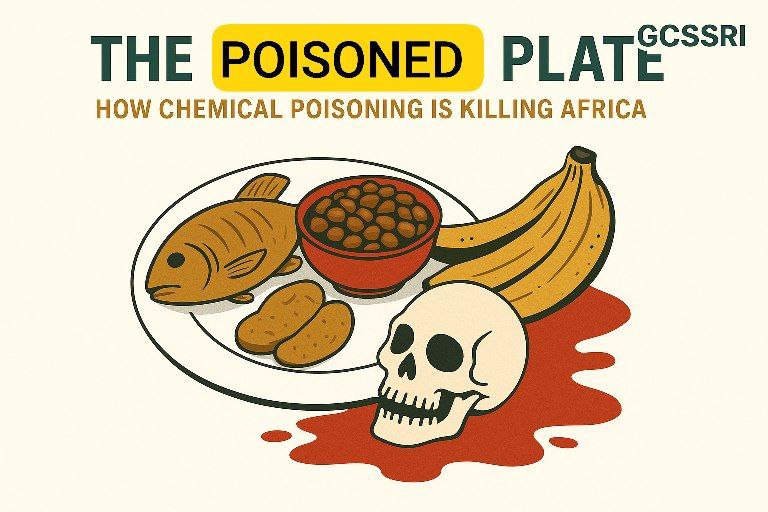
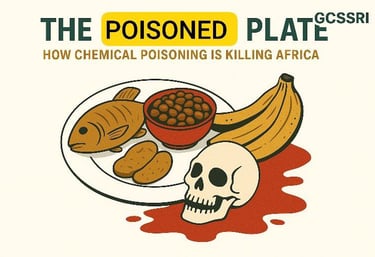
Across Africa today, something strange is happening in our markets, kitchens, and dining tables. What we call “food” is slowly becoming a silent weapon—a poison that creeps into the body unnoticed. The very things meant to give us strength are now the cause of weakness, disease, and early death.
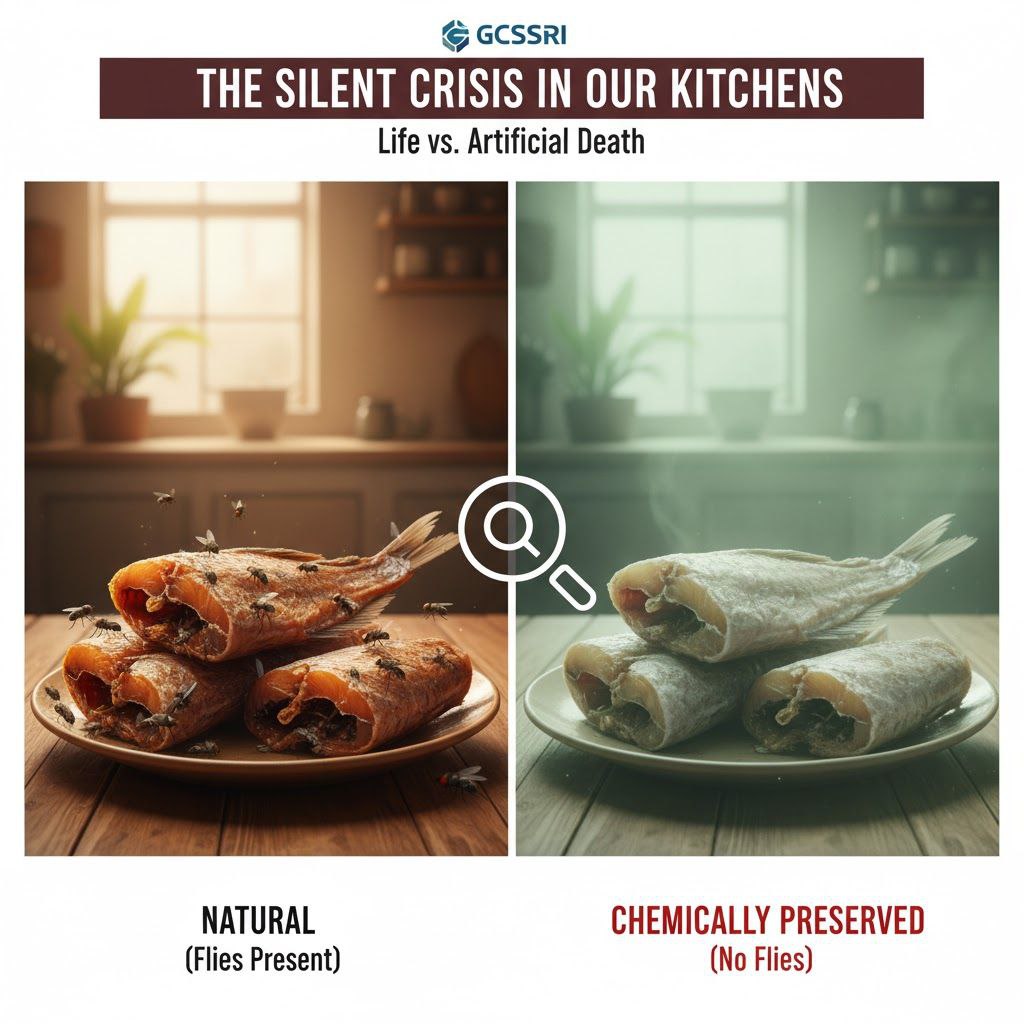
It begins innocently. You buy stockfish like Mangala, prepare it for your family, and suddenly notice something unusual—no flies come near it. You may think it’s a blessing, but in reality, it’s a warning. Nature’s small creatures sense danger faster than we do. If flies avoid the fish, it’s because it has been heavily treated with chemicals that make it unfit for consumption.
This is not an isolated incident. Across the nation, from open markets to roadside vendors, there’s a hidden practice spreading like wildfire. To keep food from spoiling, to make it “last longer,” many traders now resort to using toxic substances—the same chemicals designed to kill insects, preserve wood, or control pests in the field. These substances, when applied directly to food, transform nourishment into poison.
What we are witnessing is a deep moral and scientific crisis. Food vendors, driven by profit, ignorance, or survival, have adopted preservation methods that endanger human life. Meanwhile, government agencies that should monitor and regulate the safety of what we eat—NAFDAC, SON, and other institutions—seem overwhelmed, underfunded, or simply inattentive to the growing danger.
The result? An epidemic of unexplained sicknesses. A rise in cancers, organ failures, infertility, and chronic fatigue. Entire families consuming contaminated foods daily without realizing the invisible damage being done to their blood, nerves, and organs.
The GOA Community Services Science Research Institute (GCSSRI) has risen to expose these hidden facts and awaken the conscience of a sleeping nation. Our mission is to educate, investigate, and advocate—to bring scientific truth into public light and ensure that every African family understands the dangers lurking behind what appears to be “good food.”
This is not just science—it’s a fight for life, a call for repentance, and a demand for accountability. As we begin this investigative report, GCSSRI invites you to open your eyes and your heart to the truth:
“If the flies are not visiting your fish, it’s not because it’s clean—it’s because it’s been killed beyond life itself.”
Page 2
The Chemical Invasion in Our Food Chain
(A GCSSRI — GOA Community Services Science Research Institute Report)
As the food you buy passes from market stall to kitchen serving-plate, a hidden transformation often occurs. What once was raw, wholesome harvest becomes a chemically altered product—altered not for your benefit, but for the vendor’s immediate survival or gain. These changes happen deliberately, often in ignorance, yet the consequences are real and long-term.
The Ripening Deception
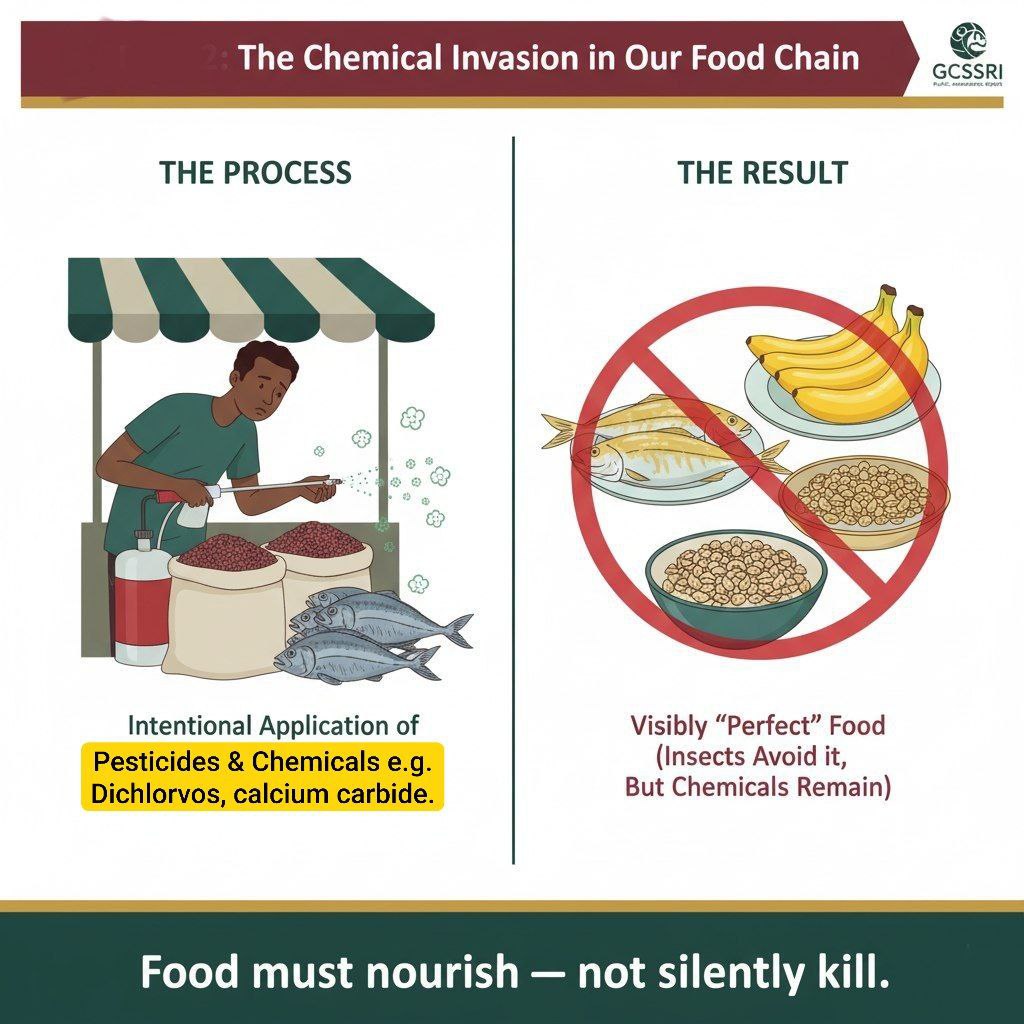
Take bananas or plantains for example: Sellers may hurry the natural ripening process by applying chemicals. The compound Calcium carbide (CaC₂), industrial-grade, is one of the most commonly used. When it comes into contact with moisture it releases Acetylene—a mimic of the natural ripening hormone ethylene.
According to NAFDAC, use of calcium carbide for ripening fruits can lead to severe health issues including kidney damage, cancer, and hypertension.
Another agent, Ethephon (which releases ethylene more cleanly than carbide), is noted in scientific literature—but neither is properly regulated in many market contexts.
The Preservation Hazard
But the danger doesn’t stop at fruits. In our grains, beans, dried fish, stockfish and crayfish, food vendors often use powerful pesticides and insecticides meant for non-food use: chemicals like Dichlorvos (also known by the brand name Sniper®) are misused to keep beans from weevils or stockfish from flies.
NAFDAC specifically warns that dichlorvos has been used on beans, stockfish and crayfish—and that long-term exposure can result in reduced fertility, memory loss, developmental abnormalities, and cancer.
Scientific reports also highlight other hazardous compounds in storage and processing: rat poisons, excessive sodium sulphite, artificial sweeteners mis-applied, colourants and stabilisers far above safe limits.
Why These Chemicals Are Used
• To make the food look “fresh”, “ripe”, or “better” for sale. A banana or plantain uniformly yellow attracts a buyer more than a green one.
• To avoid loss through spoilage—beans infested with weevils, fish attacked by flies or mites. The vendor wants to protect the stock.
• Because the knowledge gap is wide: Many traders are unaware of the science or law—they see “this chemical works” and use it.
• Because oversight is weak: The regulatory bodies, under resourced or under-pressured, cannot inspect or enforce at every market stall.
The Hidden Truth
What you see on the table—the yellow banana, the sound stockfish with no flies—is often the end result of chemical invasion.
These chemicals may not change the taste immediately; they may not burn your throat. But they change the nutrient profile, the biochemical nature of the food and introduce toxic residues into your body.
The vendors might tell you, “It will last longer, buy more,” but what is being sold is altered food, masquerading as safe.
Your responsibility as consumer
• Look for signs: If a banana is extremely yellow and ripening too fast, ask how it was ripened.
• If stockfish or beans are sold with a guarantee of “no insects, long shelf life” ask: what was used to preserve them?
• Buy from trusted sources who follow safe storage practices.
• Report suspected use of dangerous chemicals to regulatory agencies.
By exposing these practices, the GCSSRI stands with you. We believe food must nourish — not silent kill.
In our next page we will examine the science behind the poison—how these chemicals alter your body, your blood, your organs—and what early warnings you should not ignore.
Page 3
The Science Behind the Poison
(A GCSSRI — GOA Community Services Science Research Institute Report)
When food is tampered with chemicals, its appearance may still deceive the eyes, but its internal chemistry has already changed. The structure of vitamins, proteins, and enzymes that God designed to feed the human body becomes corrupted—turned into a slow-acting toxin rather than a source of strength.
1. What Really Happens Inside the Food
Each fruit, grain, or fish carries living enzymes—tiny biological workers that help break down nutrients and support digestion once eaten. When calcium-carbide gas, dichlorvos (Sniper®), or other industrial insecticides touch these foods, they oxidize and denature those enzymes. The food loses its natural ability to nourish.
• In fruits, artificial ripening through acetylene causes incomplete conversion of starch to sugar. The result is fruit that looks ripe but still carries acidic residues that irritate the stomach and damage the liver over time.
• In beans or grains, pesticide residues cling to the seed coat. When cooked, a fraction of these chemicals vaporizes, but a measurable portion dissolves into the food.
• In fish or meat treated with insecticides, the oily tissues absorb the chemical deeply—no washing or sun-drying can remove it completely.
What reaches your plate may look delicious, yet its nutrients have been chemically deactivated and replaced by trace poisons.
2. How These Poisons Build Up in the Human Body
The body cannot instantly eliminate all toxins. Some dissolve in water and leave through urine, but others, especially organophosphates (like dichlorvos) and heavy-metal impurities (arsenic, lead, mercury from adulterated chemicals), are fat-soluble. They hide inside the liver, kidneys, and fatty tissues, building up silently.
Each meal adds a new micro-dose. Over months or years, these toxins interfere with the body’s natural defense systems:
Enzyme interference: they block cholinesterase, an enzyme essential for nerve communication. The result—headaches, dizziness, and nerve weakness.
Hormonal imbalance: repeated exposure disrupts reproductive hormones, leading to menstrual irregularities and male infertility.
Oxidative stress: the body becomes inflamed at the cellular level, speeding up aging and weakening the immune system.
Liver overload: because the liver works as a filter, it absorbs most of the poison first—causing fatty liver disease, jaundice, and, eventually, organ failure.
It is not a one-day death—it is death in slow motion.
3. The Visible Signs You Should Never Ignore
Many people experience the symptoms but misinterpret them as “normal fatigue.” GCSSRI’s research highlights early warning signs linked to chronic food chemical exposure:
Persistent mouth sores or burning sensation on the tongue
Chronic fatigue and unexplained weakness
Frequent stomach upsets or bloating
Darkened nails or skin patches due to toxin accumulation
Irregular menstrual cycles or reduced sperm count
Blurred vision, dizziness, or memory lapses
Liver complications: yellow eyes, loss of appetite, abdominal swelling
Shortness of breath or chest tightness from nerve toxicity
These signs are the body’s cry for help—proof that something unnatural is entering the bloodstream.
4. The Invisible Epidemic
Every toxin-laden meal contributes to what scientists call bioaccumulation. The same way oil clogs a machine slowly until it fails, so do these chemicals clog the body’s systems. Hospitals may treat the symptoms, but the cause remains at the dinner table.
If this continues unchecked, an entire generation may grow up with weak immunity, lower fertility, and shorter life spans—without ever realizing that the poison came not from the air, but from their food.
The GCSSRI stands to declare: “Food safety is not luxury—it is survival.”
We must return to natural preservation, sunlight drying, and safe farming methods. The true solution begins when knowledge replaces ignorance.
Page 4
The Role of Poor Regulation and Public Ignorance
(A GCSSRI — GOA Community Services Science Research Institute Report)
No poison spreads widely without permission — either by silence, negligence, or failure of authority. In the case of Africa’s growing food contamination crisis, the permission came through weak regulation and public ignorance.
1. When the Watchmen Sleep
Agencies like NAFDAC (National Agency for Food and Drug Administration and Control) and SON (Standards Organisation of Nigeria) were established to protect consumers from harmful substances and ensure the safety of consumable products. Yet, over the years, these institutions have been stretched beyond their capacity — underfunded, understaffed, and sometimes undermined by corruption or political interference.
The consequence is devastating. Market inspections that should occur weekly now happen irregularly or not at all. Vendors can sell food sprayed with dichlorvos, formalin, or carbide without fear of prosecution. Random sampling of market goods for laboratory testing, which is standard practice in developed nations, is barely done at the grassroots level.
Even when chemicals are seized or banned, the enforcement rarely penetrates the open market where millions buy their daily bread. A chemical that NAFDAC classifies as “not for food use” may still be sold in the same market stall beside pepper, beans, and oil — an irony that exposes the gap between policy on paper and practice in the streets.
2. Ignorance, Not Always Evil
While greed plays a role, GCSSRI’s field interviews and community studies reveal that many food vendors act out of ignorance, not malice. To them, the pesticide that kills weevils in storage is a form of “insurance.” They have no scientific understanding of how that same chemical, when absorbed into food, destroys human nerve cells or leads to cancer.
The problem is educational poverty.
The trader knows how to measure profit, but not poison.
The farmer knows how to grow, but not how to store safely.
The food hawker knows how to sell, but not how to identify chemical residues.
Without regular sensitization campaigns, people continue the dangerous cycle — using what “worked for their neighbour” without knowing the long-term cost.
3. The Systemic Chain of Neglect
The failure is not one-sided. It runs through the entire chain:
Importers who bring in industrial-grade chemicals and repackage them for food use.
Distributors who sell these toxins in local markets without warning labels.
Market authorities who collect levies but ignore inspection.
Consumers who buy cheap, brightly coloured foods without asking questions.
Each link in the chain reinforces the other, forming a nationwide system of chemical normalization. Everyone sees it, yet no one stops it — because the damage is invisible, delayed, and quiet.
4. The Cost of Silence
Every nation pays for what it ignores.
When food safety collapses, healthcare costs rise. Hospitals fill up with patients suffering from liver, kidney, and hormonal diseases whose roots trace back to unsafe meals. The economy loses strength as citizens become sick and unproductive.
What began as “a harmless shortcut to preserve food” ends as a national health tragedy.
It is not enough to blame the agencies; we must awaken the conscience of the people. Regulation without education is powerless. Education without enforcement is useless. Both must walk hand in hand.
The GCSSRI calls on the authorities to return to the markets, not just with paperwork, but with presence — with testing kits, with education teams, and with a commitment to protect the nation’s bloodstream: its food.
“A sleeping regulator and an ignorant vendor create the same result — poisoned citizens.”
— GOA Community Services Science Research Institute (GCSSRI)
Page 5
The Hidden Blood Wealth — Greed and Survival
(A GCSSRI — GOA Community Services Science Research Institute Report)
Every poison in the market has a price tag. Behind every contaminated fish, every artificially ripened fruit, every pesticide-laced bean lies a story of profit — and a soul choosing gain over life. The tragedy of our food system is that the pursuit of survival has slowly become the trade of death.
1. When Profit Becomes the Poison
Food adulteration is no longer a hidden act; it has become a strategy of survival. Vendors and traders say, “If I don’t preserve it this way, I’ll lose everything.” The result is a moral inversion — we now call what kills “wisdom,” and what preserves life “foolishness.”
In the name of profit, fruits are ripened overnight using carbide because natural ripening “takes too long.” Fish are soaked in insecticides because refrigeration “costs too much.” Grains are sprayed with dichlorvos because proper storage “requires space.”
But every shortcut comes with a cost. The profit made today becomes the hospital bill of tomorrow. And worse, it becomes the blood wealth of a nation eating its own strength.
GCSSRI researchers describe this as the “economy of slow death” — a vicious cycle where greed, poverty, and ignorance collaborate to poison both the body and the conscience of society.
2. The Desperation Behind the Deception
The average market trader is not a villain; they are often victims of a system that forces them to choose between hunger and harm.
Without affordable electricity, they cannot refrigerate fish.
Without government storage facilities, they cannot protect grains.
Without access to scientific education, they cannot identify the danger of using industrial chemicals for food preservation.
So, they adopt what “works” — and sell what “sells.” In the process, they unknowingly exchange daily bread for daily death.
This is the hidden tragedy: a generation of hardworking men and women poisoning the same communities they seek to feed. Poverty may be the reason, but ignorance is the weapon.
3. The Blood Economy of the Market
What used to be the sacred act of feeding one’s neighbour has turned into a transaction of blood. Every toxic plate sold, every meal adulterated, is a silent exchange of life for money.
The food industry, at the top, profits the most. Distributors of unregulated chemicals grow richer as public hospitals grow fuller. Vendors make quick sales while the cost of disease multiplies silently across families.
We are caught in a deadly trade — selling death in the name of daily bread.
“We are eating what’s killing us — and calling it survival.”
This is not just an economic failure; it is a spiritual corruption. When profit overshadows the value of human life, we lose the essence of community and the fear of God.
4. The Call for a New Moral Economy
The GCSSRI declares that true survival is not found in chemical deception but in knowledge, honesty, and divine accountability.
Our markets must be reformed from the inside out — through education, food inspection, and faith-based moral awakening.
The vendor must understand that each sale is sacred, each customer’s life is entrusted to their hands.
Until we return to this truth, the wealth we build through poisoned food remains bloodstained — a false prosperity purchased at the cost of health and humanity.
“There is no blessing in a market that profits by death.” — GOA Community Services Science Research Institute (GCSSRI)
PAGE 6
My Scientific Discovery — The GCSSRI Findings
When the GOA Community Services Science Research Institute (GCSSRI) began its field investigations, we never expected the findings to be so alarming. What started as a simple observation — that stockfish, beans, and plantains were lasting unnaturally long without decay — led us into a deeper scientific inquiry.
During our tests, we collected samples from open markets and food stalls across several regions. The first phase involved chemical residue analysis using basic pH testing and heat exposure observations. When we applied mild heat and moisture to samples of “preserved” stockfish and beans, we noticed a strange reaction — a smoky odor similar to industrial pesticide fumes. That was our first red flag.
Further laboratory testing revealed traces of chlorpyrifos, aldrin, and carbofuran — highly toxic agricultural pesticides that are never meant for food preservation. Some dried fish samples even contained remnants of formalin — a chemical used in embalming corpses. Beans, in particular, showed residues of DDT and aluminum phosphide (the active ingredient in rat poison tablets), often applied by traders to keep weevils away.
The scientific explanation is simple but frightening: these chemicals penetrate deeply into food tissues. Heat from cooking does not neutralize them completely. Instead, their molecular fragments bind to natural food enzymes, altering nutritional structure and creating slow-reacting toxins. The GCSSRI team discovered that even micro doses of these substances, when consumed continuously, accumulate in fatty tissues and the liver — eventually leading to neurological decay, infertility, and cellular damage.
This discovery is not just data; it’s a national alarm. It shows that millions of citizens are silently being poisoned under the banner of “food preservation.” The GCSSRI findings mark the beginning of a new phase in African food awareness — a movement to expose what the eyes cannot see but what science can prove.
The mission now is not only to publish these findings but to educate the public — from market traders to household consumers — that preservation does not have to mean destruction. We must return to the wisdom of natural storage: sun-drying, clay containers, smoke preservation, and organic repellents.
Our goal is clear:
“To bring truth to the table, purity to our food, and life back to the body of our people.”
PAGE 7–8
The Health Impact on African Society
Across Africa today, a silent epidemic is spreading — not through the air or water, but through the very food we eat. The same meals that should nourish the body are becoming slow instruments of death. The findings from GCSSRI (GOA Community Services Science Research Institute) reveal that food toxicity has become one of the most underestimated public health crises of our generation.
While official records may underreport the reality, medical experts estimate that over 150,000 premature deaths annually in sub-Saharan Africa are connected to toxic food exposure — directly or indirectly. Hospitals are filled with people suffering from chronic liver and kidney diseases, yet few realize the roots trace back to years of eating chemically treated foods. In our field interviews, we encountered countless stories: young men with early-stage liver failure; women battling unexplained infertility; children developing strange skin reactions after meals.
The science is simple but terrifying. When people consume foods treated with industrial preservatives such as formalin, carbofuran, dichlorvos (Sniper), and aluminum phosphide, these toxins build up in the bloodstream. Over time, they weaken immune systems, distort hormones, and attack internal organs. What appears as “tiredness,” “body weakness,” or “persistent malaria” is, in many cases, the slow decay caused by cumulative chemical exposure.
But beyond the science lies the emotional truth — the faces behind the statistics.
Mothers watching their children grow weaker despite feeding them three times a day. Fathers who work long hours to provide, only to see their strength fade before middle age. Entire families losing their loved ones to what doctors label “natural causes,” never realizing it was the market food that slowly poisoned them.
Every bag of preserved beans sold without regulation, every fish soaked in embalming fluid to appear fresh, every fruit ripened with calcium carbide to attract buyers — is another drop of blood wealth drawn from innocent consumers. It is the economy of survival built on the pain of a people.
And yet, this suffering continues because the system has turned away. Regulatory agencies are underfunded, inspections are rare, and education on food safety is nearly nonexistent. The ordinary African, struggling to make ends meet, buys whatever is affordable, unaware that cheapness has become the disguise of poison.
It is in this moment of despair that GCSSRI’s mission becomes sacred. We are not just speaking science — we are defending life itself. We are amplifying the cry of a mother who has buried her child, of a farmer who unknowingly poisons his harvest, of a nation slowly losing its strength through its stomach.
“We are what we eat — and right now, Africa is being poisoned through her plate.”
If we do not act now, the damage will not only be biological but generational. Our DNA will bear the scars of our neglect.
But there is hope — because awareness is the beginning of deliverance.
And GCSSRI will continue to uncover, document, and enlighten until every home knows the truth that the food industry has long hidden.
PAGE 9–10
The Call for National Reformation and Food Revival
(Solutions and GCSSRI’s Future Plan)
The journey toward a safer, healthier Africa begins not with fear, but with truth and reform. The findings of the GOA Community Services Science Research Institute (GCSSRI) are not merely to expose danger — they are to ignite change. For decades, ignorance and greed have built invisible walls between life and death in our food system. Now, it is time to tear those walls down.
1. National Reformation: Restoring Accountability in Food Safety
No society can thrive on poisoned food. We must call for a national reawakening — a total reform of our food regulation system. Agencies like NAFDAC and SON must be strengthened, depoliticized, and properly funded to enforce real inspection standards in open markets. Food testing should no longer be limited to industries; random sampling of market products must become routine. Every local government should have a community food lab, capable of testing for chemical residues before products reach the public.
GCSSRI proposes a Food Truth Policy, where every food product sold — from dry fish to packaged beans — carries a transparent record of preservation methods. Let the people know what they are eating; truth itself will drive the market to reform.
2. Public Enlightenment: From Ignorance to Awareness
The GCSSRI field team discovered that most traders and farmers who misuse chemicals do so not out of malice, but because they were never taught safer methods. They are victims of a broken system, where profit overshadows education.
Our next step is mass education — taking food safety awareness into schools, markets, and churches. GCSSRI will launch the “Clean Plate Campaign”, teaching citizens how to identify chemically altered foods, how to detoxify, and how to return to natural preservation practices:
Smoking and sun-drying for fish and meat.
Use of neem leaves, pepper, or ashes to protect grains from weevils.
Ripening fruits naturally using warmth and time, not calcium carbide.
Storing foods in airtight clay or wooden containers instead of nylon bags that trap toxins.
3. Scientific Innovation and Indigenous Wisdom
Africa does not lack intelligence — it lacks investment in its own wisdom. The GCSSRI plans to establish Regional Research Units across major cities, combining traditional African food wisdom with modern science. Our goal is to develop organic preservatives and affordable natural pesticides that can replace deadly chemicals in the markets.
4. The Moral and Spiritual Awakening
We must also recognize that this crisis is not only scientific but spiritual. The greed that drives the adulteration of food is a moral disease. We cannot heal the body of the nation until we heal its conscience. Let every vendor, farmer, and policymaker hear this truth:
“When you sell poisoned food, you are selling blood — and no wealth built on blood will stand.”
GCSSRI calls upon the nation’s spiritual leaders, health workers, and educators to unite for a national food revival. A movement where truth replaces greed, and nourishment replaces death.
5. GCSSRI’s Future Plan: Science for Life
Our next phase includes publishing the “African Food Safety Blue Book”, documenting verified chemical dangers, natural alternatives, and field data from across Nigeria and beyond. This publication will serve as both a public guide and a scientific foundation for policymakers and schools.
GCSSRI also plans to host the African Food Integrity Summit, bringing together scientists, traders, and health officials to forge a new code of ethics for food production and sales.
Closing Statement
The fight for safe food is not a campaign — it is a covenant with life.
We cannot remain silent while generations are fed poison in the name of preservation. The time to act is now.
“The table of Africa must become a table of life again.
From the markets of Lagos to the villages of Enugu, from the rivers of the Niger to the deserts of the North — we must rise and defend our right to pure food, pure health, and pure living.”
This is the voice of GCSSRI,
and we will not stop until truth feeds every home.